
Lou St. Laurent
OCEAN ENERGETICS
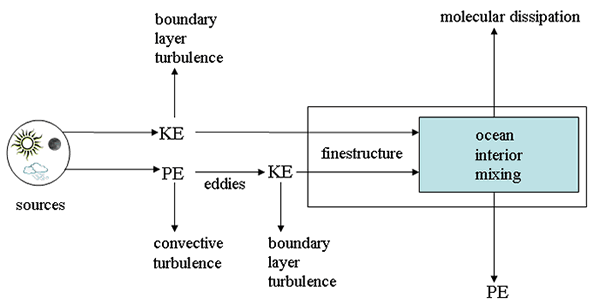
This schematic shows various avenues of energy flow between large-scale sources and dissipation.
Some kinetic energy (KE) is dissipated in boundary layers, but some energy cascades to the scale
of oceanic finestructure where it is used by turbulent processes to producing mixing and buoyancy
flux. Potential energy (PE) also moves in an energy cascade, in some cases dissipating through convective
process, but in other cases generating kinetic energy through the generation of mesoscale eddies
(St. Laurent and
Simmons 2006  ).
).
Ocean energetics relates to the flow of energy between different scales of motion down to the scale of turbulent dissipation and mixing. The ocean is a vast thermodynamic machine, powered by the sun, the winds, and the tides. There is no concept more fundamental to the ocean than energy; it characterizes the flow of waters and the transfer of heat between warm and cold regions. The flow of energy in the ocean system, together with the flow of energy in the atmosphere, controls the climate state of the Earth.
My studies focus on the transfer of energy from large- and mesoscale oceanic flows to smaller dissipative scales. Internal waves are central to this process, as they are perhaps the only mechanism that acts in the range of scales between the mesoscale (eddies) and the turbulent processes that lead mixing and diffusion.
Reviewed Publications
St. Laurent, L. and J. Nash, 2004. An examination of the radiative and dissipative properties of the internal tides. Deep-Sea Research II, 51, 3029—3042, doi:10.1016/j.dsr2.2004.09.008.
Additional Publications
St. Laurent, L., and J. Nash, 2003. On the fraction of internal tide energy dissipated near topography. In Proceedings of the 'Aha Huliko'a Hawaiian Winter Workshop, 45--58.
St. Laurent, L., and C. Garrett, 2002. Energy dissipation by internal ocean tides. Bulletin of the American Meteorological Society, 83, 1457--1458.
